
This study serves as the foundation for a new international positioning campaign led by Autoparts From Spain, the platform that brings together the main Spanish suppliers of automotive components.
An increasing number of manufacturers, investors, and strategic partners are looking to the components ecosystem manufactured in Spain as a safe and forward-looking investment. Below, we review the key arguments that make Spain a strategic choice for global investors, manufacturers, and partners in the automotive components sector.
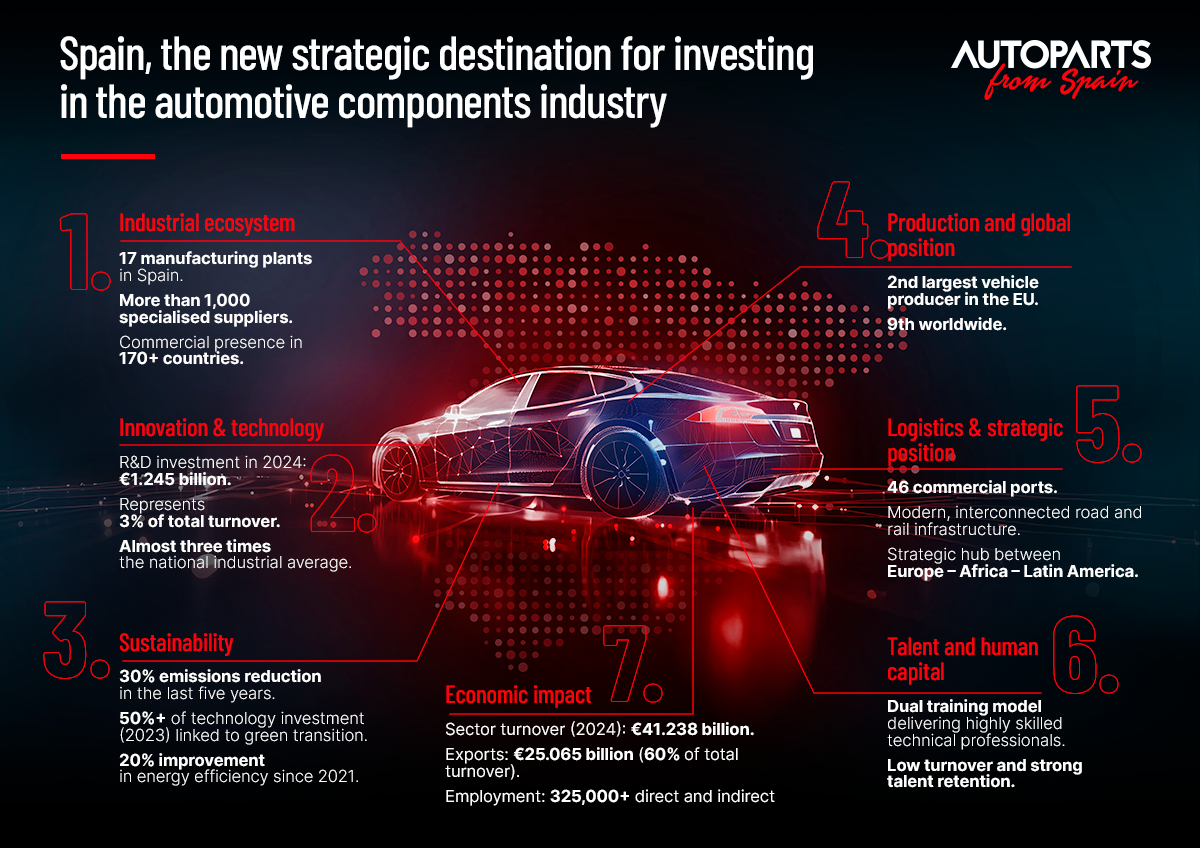
Spain is the second-largest vehicle producer in the European Union and ranks ninth worldwide. The ecosystem includes 17 manufacturing plants, more than 1,000 specialized suppliers, and commercial presence in over 170 countries.
This robust, flexible, and technologically advanced industrial fabric enables Spanish suppliers to collaborate simultaneously with OEMs from various nationalities (European, American, Japanese, Chinese…), meeting the highest international standards.
Commitment to R&D&I is one of the sector’s major competitive advantages. In 2024 alone, the Spanish components industry invested €1.245 billion in research, development, and technological innovation, equivalent to 3% of its total turnover.
This represents almost triple the national industrial average and positions the ecosystem among the most advanced in key areas such as electrification, autonomous driving, process digitalization, circular economy, and eco-design.
Spain has a dual training model that integrates theory and practice through collaboration between companies, educational centers, and technology institutions.
This has enabled the development of a generation of technicians and engineers with high employability, strong practical orientation, and the ability to lead international projects from Spain. Low staff turnover and high talent loyalty further reinforce stability and continuity in industrial teams.
In the past five years, the sector has reduced its emissions by 30%, and more than 50% of technological investment in 2023 was allocated to green projects.
Spanish companies have increased their investment in energy efficiency by 20% since 2021. Additionally, the ecosystem is aligned with the objectives of the European Green Deal, promoting strategies related to circularity, electrification, traceability, and the use of recyclable materials..
Spain’s geostrategic location—with direct access to Europe, Africa, and Latin America—is complemented by a powerful logistics network that includes 46 commercial ports, a modern rail and road system, and logistics hubs interconnected with industrial clusters.
This makes Spain a natural bridge between continents, ideal for establishing regionalized, resilient, and competitive supply chains.
Despite the complexities of the global environment in 2024, the Spanish automotive components sector maintained a turnover of €41.238 billion, achieved exports of €25.065 billion (60% of the total), and generated more than 325,000 direct and indirect jobs.
These figures confirm the strength of the industry, its international focus, and its strategic role in the Spanish economy. The combination of talent, innovation, sustainability, a solid industrial foundation, and global connectivity positions Spain as a key player in leading the transition toward smarter, safer, and more decarbonized mobility.
At Autoparts From Spain, we reaffirm our commitment to strengthening the sector’s international presence by fostering collaborations and alliances that reinforce the Spanish automotive components industry’s position on the global mobility map.

Automechanika Frankfurt 2026 has wrapped up, breaking records along the way. Discover the closing numbers, the technologies that defined this edition, and how Spain made its mark.

Automechanika Frankfurt 2026 has arrived, and Spain is making its mark once again. Find out which manufacturers are exhibiting, where their stands are, and what's driving their push into international markets.

The diesel injector is a key component of a vehicle's fuel injection system. Discover how it works, the different types of diesel injectors, their main applications and why injection precision is essential for engine efficiency, performance and emissions.